Принцесата от двете кралства (The Princess of Two Kingdoms)

Thank you, Bobby, for your wonderful story and for being such an inspiring part of our international network!

November 14, 2025 from Bobby

Принцесата от двете кралства

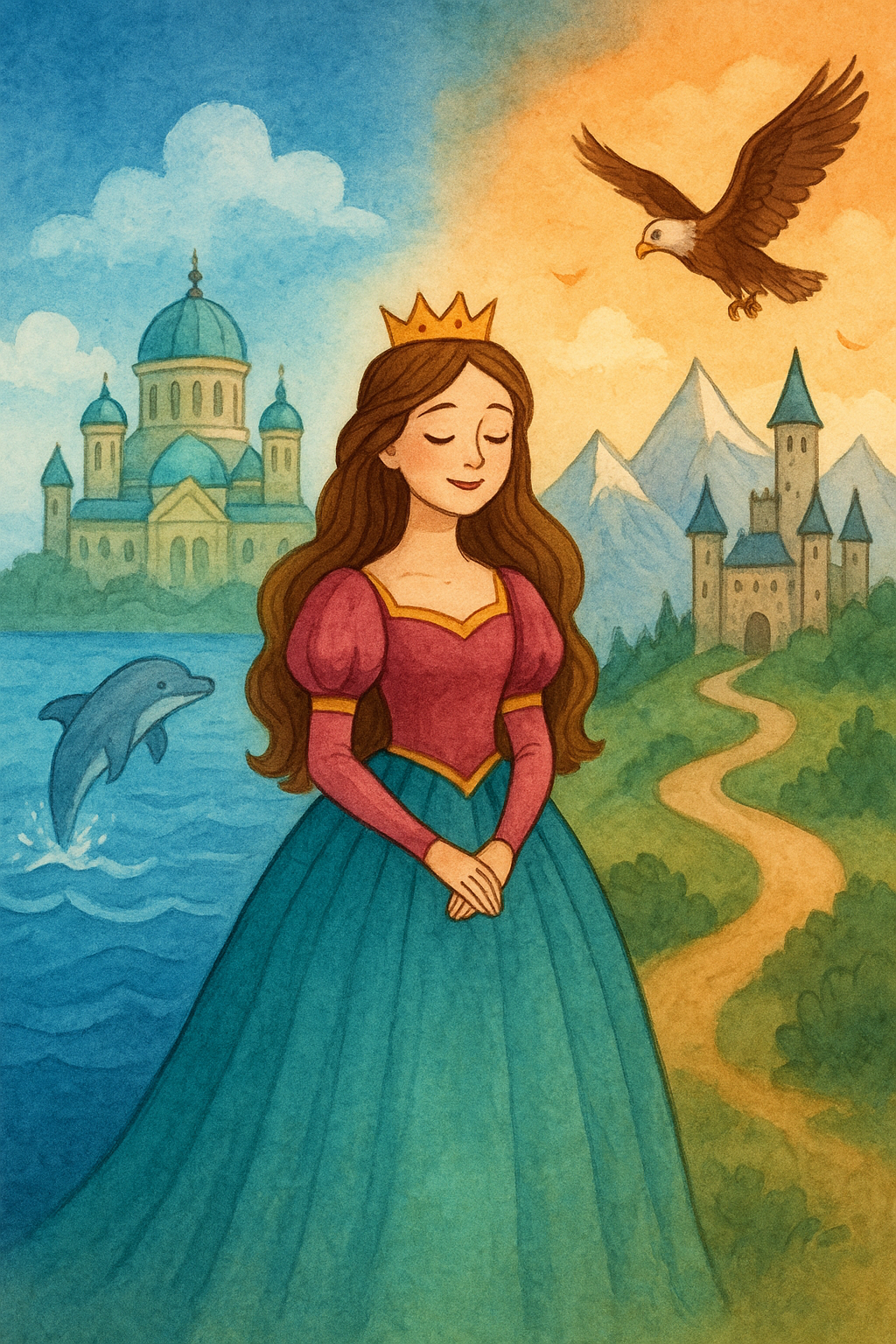
Имало една принцеса, която била принцеса на две кралства. Тя била наследница на два велики рода – родът на морското кралство и родът на планинските върхове. Принцесата била много щастлива ще е има два двореца. На две места за нея се грижели прекрасни придворни дами. Има два гардероба с прекрасни рокли. И била обичана и обгрижвана и на двете места. Единственият проблем в двете кралства била разликата във въздуха – долу в морското кралство въздухът бил плътен, налагало се да използва магическата си сила, за да диша под вода , за да стигне до замъка и някак налягането било по – тежко, от водата над замъка. Горе пък, в кралството на планинските върхове въздухът бил разреден, и тялото и се нуждаело от време , за да се адаптира към двете места. Но ползите били прекрасни – тя летяла на крилете на орлите, плувала заедно и върху красиви делфини – в зависимост от това, в кое кралство се намирала. Вярно, понякога се будела нощем и търсела делфините, когато осъзнавала, че някой прекрасен орел я очаква за среднощна разходка, но бързо се справяла с това.

И в двете кралства имало по една забранена за принцесата зона – тъмни места, в които живеели вещици. Царедворците и в двете кралства се страхували, че ако принцесата отиде там, ще я отвлекат или отровят, че ще и сторят нещо, затова не пускали да иде там.

Нашата принцеса, обаче била приключенка и един ден, докато седяла в двореца в морското кралство, решила че ще отиде до забраненото място. Там видяла прекрасни жени, прилични на русалки, били красиви и вълшебни и тя се влюбила в тях. Решила да им се покажи, а те толкова се зарадвали, че я виждат, че я прегърнали и затанцували с нея. Не ѝ направили нищо лошо и тя поискала да остане при тях известно време. Те я приели и я научили да прави вълшебни отвари , с които да лекува хората и красиви щитове, които да я пазят от всякакво зло. Скоро и домъчняло за семейството ѝ и тя се прибрала у дома . Там били много уплашени , но се успокоили, когато видели, че е добре. Порадвали ѝ се и я изпратили в кралството на високите върхове. Там тя се забавлявала, но любопитството ѝ отново надделяло и тя решила да отиде при вещиците и в това кралство. Царедворците били предупредени, че е била при вещиците в морското кралство и я охранявали доста добре. Но с помощта на най – верния си паж, тя успяла да се измъкне и отишла при тяхното място. Там видяла прекрасни и красиви самодиви, които ѝ казали, че са много щастливи да я видят и че принцеса на две кралства се ражда веднъж на 1000 години и че това че тя съществува означава, че юе има мир, любов и благоденствие през следващите 1000 години. Тя останала доброволно прия тях и те я научили да приготвя вълшебни ястия, с които да прави хората щастливи и да използва думите, така че да може да лекува вътрешния свят и тревогите на хората. Когато била научена на всичко, тя се прибрала в кралството, където я посрещнали с тревога, но скоро разбрали, че всичко с нея е наред. Оттогава на вещитите от двете кралства било позволено да ходят където си искат и да лекуват хората, а принцесата била техен обединител. И се сбъднало пророчеството всички да живеят щастливо следващите 1000 години.

За дете, което живее 2 седмици при единия си родител, 2 седмици при другия. И двамата родители имат партньори.
The Princess of Two Kingdoms

Once upon a time, there was a princess who was a princess of two kingdoms. She was the heir of two great lineages – the lineage of the sea kingdom and the lineage of the mountain peaks. The princess was very happy to have two palaces. In both places, she was cared for by wonderful court ladies. She had two wardrobes with beautiful dresses and was loved and cared for in both places. The only problem in the two kingdoms was the difference in air – down in the sea kingdom, the air was dense, and she had to use her magical power to breathe underwater to reach the castle, and somehow the pressure was heavier due to the water above the castle. Meanwhile, in the kingdom of the mountain peaks, the air was thin, and her body needed time to adapt to both places. But the benefits were wonderful – she flew on the wings of eagles and swam alongside and on beautiful dolphins, depending on which kingdom she was in. True, sometimes she would wake up at night looking for the dolphins, only to realize that a magnificent eagle awaited her for a midnight stroll, but she quickly managed this.

In both kingdoms, there was a forbidden zone for the princess – dark places where witches lived. The courtiers in both kingdoms feared that if the princess went there, she would be kidnapped or poisoned, that something would happen to her, so they did not allow her to go there.

However, our princess was adventurous, and one day, while sitting in the palace in the sea kingdom, she decided to go to the forbidden place. There she saw beautiful women resembling mermaids, they were enchanting and magical, and she fell in love with them. She decided to reveal herself to them, and they were so delighted to see her that they hugged her and danced with her. They did her no harm, and she asked to stay with them for a while. They welcomed her and taught her to make magical potions to heal people and beautiful shields to protect her from any evil. Soon, she missed her family and returned home. They were very worried but calmed down when they saw she was well. They rejoiced at her return and sent her to the kingdom of the high peaks. There she enjoyed herself, but her curiosity got the better of her again, and she decided to visit the witches in this kingdom too. The courtiers had been warned that she had visited the witches in the sea kingdom and guarded her well. But with the help of her most loyal page, she managed to slip away and went to their place. There she saw beautiful and enchanting fairies who told her they were very happy to see her and that a princess of two kingdoms is born once every 100 years and that her existence meant there would be peace, love, and prosperity for the next 100 years. She stayed with them willingly, and they taught her to prepare magical dishes to make people happy and to use words to heal the inner world and worries of people. When she had learned everything, she returned to the kingdom, where she was greeted with concern, but they soon realized that everything was fine with her. From then on, the witches from both kingdoms were allowed to go wherever they wanted and heal people, with the princess as their unifier. And the prophecy came true for everyone to live happily for the next 100 years.

This story can be interpreted as a metaphor for a child who lives two weeks with one parent and two weeks with the other. Both parents have partners.
Függőség  (Addiction)

I owe thanks for this story to Attila Mislai who translated it.

„Mi ez a hatalmas, ronda dudor a hüvelykujjamon?” Három évesen kérdezte ezt az anyjától. Napok óta vizslatta a kerek, sárgás duzzanatot, nem tudta kiverni a fejéből. „Az egy hólyag. Szopod az ujjadat, azért.” ”Ha abbahagyom, eltűnik?” ”Igen.” Szentül megfogadta. Ez volt az első felnőtt elhatározás az életében.

This story in English: https://www.stefanhammel.com/blog/2014/05/12/2756/

Какво е позволено да правят плевелите… (The Potential of Weeds)

” Какво е позволено да правят плевелите ” е история за справянето с принципите. Всеки принцип се прилага в контекста, от който произлиза. Новите ситуации изискват преразглеждане на прилаганите досега принципи. Принципите на мислене и действие, възприети от други контексти, могат да доведат до спиране на по-нататъшното развитие.

Какво е позволено да правят плевелите…

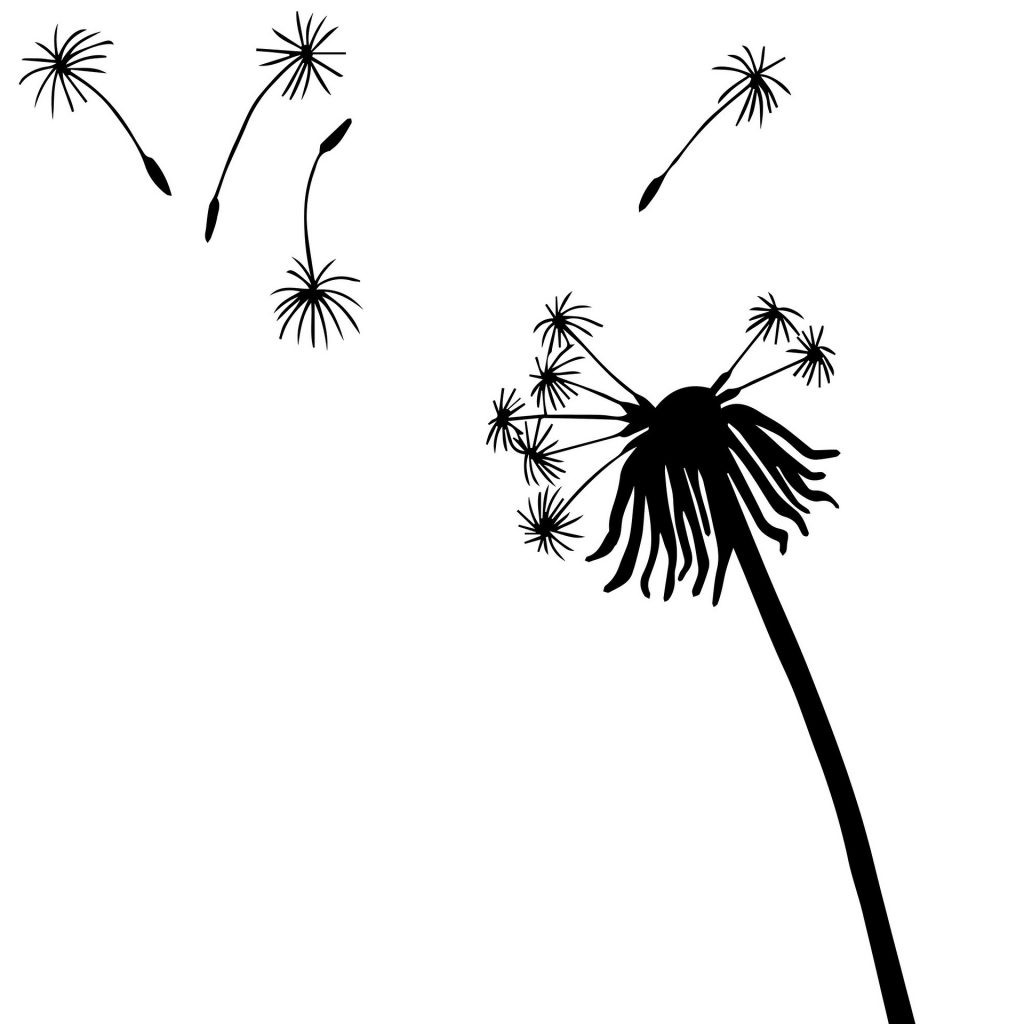
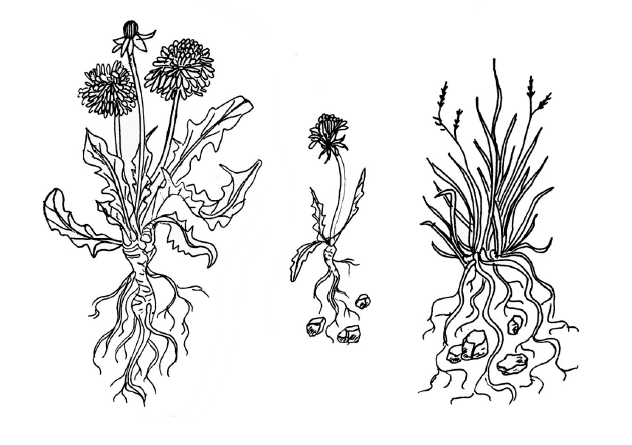
Дълго време те мълчаха. Тогава малкото глухарче попитало големия си съсед: „Какво правиш в момента?“ „Тренирам корена си“. „Аз също го правя. Но от няколко дни не съм постигнал никакъв напредък. Коренът ми се е ударил в камък.“ „Вижте как го прави канапето. Позволи на корена си да расте около камъка. Ако е необходимо, образувай няколко корена“, каза голямото глухарче. „Не ми е позволено да правя това“, каза малкото. „Коренът си е корен.“ И си остана малко.

This story in English/ Тази история на английски език:

Бих искала да благодаря на илюстратора Василена Димитрова за предоставянето на снимките:

На 27 и 28 октомври 2025 г. в София ще проведа семинар за терапевтично разказване на истории.

Повече информация можете да получите от Българската асоциация по хипноза и хипнотерапия (БАХХ).

С най-добри пожелания
Стефан

“Hammel Digital” – AI assistant for utilization and supervision

I asked an AI developer to build me a chatbot with offers for therapeutic interventions based on my manual for therapeutic utilization, among other things.

The prototype has been refined and improved over the last few months.

You can find the AI assistant for Utilization and Supervision embedded in my

🔗 Blog.

If you feel like it, you can play around with it (e.g. ask: “my client suffers from moth phobia and tinnitus, how can I help her therapeutically / do you have a story I can tell her) and write me what positive / negative experiences you have had with it and what you think should be improved.

The AI also works if you speak to him in other languages.

I look forward to your feedback 📧.

Your Stefan

The Potential of Weeds

“The Potential of Weeds” is a fable about principles. Every principle applies only in the context from which it originates, and a change in circumstances makes it necessary to review the principles which previously applied. Principles which dictate how to think and act in a particular situation may impede development if they are carried over to different situations.

They were silent for a long time. Then the little dandelion asked his much larger neighbour, “What are you doing?” “I’m growing my taproot.” “That’s what I’m doing too. But I’ve made no progress for days. My root has hit a stone.” “Just do what the couch grass does and grow your root around the stone. Grow more roots if necessary,” said the big dandelion. “I can’t do that,” said the small dandelion. “A taproot is a taproot.” And he never grew any larger.

The Replanted Tree

The story “The Replanted Tree” is designed in particular for children finding
it hard to come to terms with a new living situation after a house move
or adoption, or after their parents have divorced and the family has been
restructured. Once again, it is a good idea to refer to a minor injury in the
story in order to incorporate the problem which the listener is facing and its
predicted improvement without lending too much gravity to the story (and by
analogy to the way in which the patient handles the associated situation in his
or her life). The story can also be used for patients who are forced – for agerelated
or health- related reasons – to move out of their own house in order to
go and live with family or in a home, or adults with disabilities who are forced
to move away from their families and into sheltered accommodation.

One day a gardener was working in his garden when he found a small tree
right in the middle of some shady undergrowth. “A shadbush!” he cried.
“How on earth did that get here?” He would never have suspected that
such a beautiful and valuable tree could be found in such a dark location.
Perhaps the wind or a bird had carried its seeds there?
The gardener thought carefully about what he should do next. He
knew that it is sometimes diffi cult to move a plant to a different location,
but he also knew that his shadbush would never grow into a large, strong
and beautiful tree if it stayed here in the shade. So he decided to replant it
in a different location, where it would get enough sun and wind to thrive
and fl ourish. He took his spade and dug out a broad ring of soil around
the trunk of the tree before digging a hole in the ground where he wanted
the tree to grow and placing the shadbush there, root ball and all. He then
fi lled the hole back up with soil, added exactly the right amount of fertiliser,
and gave the plant a good watering.
When he looked at his tree the next day, he was dismayed to see that all
the leaves on it were drooping. He thought to himself that the tree’s roots
had probably extended a long way under the ground before it had been
dug up, and that it must have lost some of its tiniest hair- like roots. The
tree would need to conserve its energy to heal these injuries, but it should
be able to regrow its roots, and so the gardener decided to give his tree the
best possible care and simply be patient. He waited and gave the tree all
the time it needed, and soon the leaves had indeed regained their former
strength. After a few months the tree was a fi ne specimen, and after a few
years it had grown into a large and strong tree.

Terminé!

« Terminé! » , cria l’œuf quand il fut pondu. « Maintenant terminé! » , cria le tétard quand il fut sortie de l’œuf. « Maintenant je suis au complet! », cria la créature quand elle eut deux pattes. « Je suis enfin au complet de la tête aux pieds! » , cria l’être, quand il eut quatre pattes et une longue queue. « Qui sait ce qui va désormais encore se produire… » , dit la grenouille quand elle fut terminée.

Le loup de mer et le loup de terre

Un jour, le loup de mer reҫu la visite du loup de terre. Les deux se connaissaient déjà depuis l’école des loups. Le loup de mer avait parcouru le monde et vécut beaucoup d’aventures et il rentra chez lui riche de trésors et d’expériences. Le loup de terre était resté chez soi dans sa tannière. Il rencontra une louve de terre et eut des louveteaux de terre. Et maintenant, il a beaucoup de petits-louveteaux et des arrière-petits-louveteaux, et tous sont devenus de vrais, bons loups de terre.

«Parfois j’aimerais refaire ma vie», dit le loup de terre au loup de mer. «C’est la même chose pour moi», dit ce dernier. «Je ferais beaucoup de choses différemment», dit le loup de terre. «Oui, moi aussi», répondit le loup de mer. «Je naviguerais les océans», rêva le loup de terre. «Je me marierais», soupira le loup de mer. «Je vivrais des aventures», expliqua le loup de terre. «J’aurais des louveteaux», dit le loup de mer. «Je serais un loup de mer riche. J’aurais vécu des expériences  périlleuses et magnifiques, dont je pourrais raconter les histoires», dit le loup de terre avec enthousiasme. «Moi, j’aurais des petits-enfants et des arrière-petits-enfants qui m’aimeraient et qui s’occuperaient de moi quand je serais vieux et malade», assura le loup de mer.

«Et ce serait moi qui serait maintenant assis avec toi dans cette tannière de loup de mer», continua le loup de terre, « …et moi avec toi… », rajouta le loup de mer. Le loup de terre hocha la tête : «Et puis maintenant tu me dirais : “Parfois, j’aimerais bien refaire ma vie” et moi, je répondrais : “Oui, c’est la même chose pour moi.”»

La brizna de pasto en el desierto

Un hombre estaba atravesando el desierto. Al rededor de él no había nada más que arena, piedras y rocas, el cielo azul reluciente y el sol ardiente. En la mitad de su camino se le ocurrió descansar y buscó un lugar adecuado. Un poco lejos del camino encontró un peñón que le podía ofrecer sombra durante su descanso. El hombre se acercó. Al llegar vió algo raro: En la sombra de le roca crecía una brizna de pasto, de hecho.
“¡Qué sorpresa! ¿De dónde vienes tú?”, le preguntó el hombre. Después se rió de si mismo:
“Estoy tan solo que empiezo hablar con la hierba. Será mejor examinar de donde viene ella.”
Excavó la plantita de la arena y la puso al lado cuidadosamente. Después empezó a cavar más y más profundamente. Aunque no tropezara con un manantial brotante, en ese lugar el suelo estaba verdaderamente mojado. Cuando el hombre de nuevo se puso en camino no olvidó de reponer la brizna en la tierra mojada. Con unas piedras construyó un pequeño muro para proteger la planta contra la desecación por el viento caliente del desierto. Después siguió caminando.
Al regresar pasó por el mismo lugar. Por supuesto miró si su pequeña planta estaba viva. Se alegró mucho: La brizna se había vuelto en un verdadero pequeño manojo de hierba. El hombre cavó un poco más profundamente y llegó a una parte aun más mojada de la tierra. Con un pañuelo, dos palos y unas piezas de cuerda, que había traído para el regreso, mejoró la protección de su planta contra el viento.
Muchos años después un amigo del hombre tuvo que atravesar el mismo desierto. Entonces le pidió a su amigo: “Pues mira qué fue de mi planta – si todavía existe.” El amigo se lo promitió. Cuando éste volvió del viaje le contó: “Tu manojo de hierba se ha vuelto en una pequeña pieza de prado. Otros viajeros han encontrado el lugar. Han subido el muro y puesto más palos con pañuelos. Alguién ha cavado un pozo y lo ha cubierto con una pieza de cuero. Al lado del pozo crece una hermosa higuera . En sus hojas canta un grillo.”

Everything Else

In a land in our time there lived a man, who read a book and found lots of wonderful stories therein. There were true and invented stories, experienced and pensive, enjoyable and painful stories. There were stories which contained stories, and such which were actually not stories. For every story he read, there occurred to him nearly five which he had either experienced or thought up himself. So the thought came to him, that a lot in the world was a story which could be healing for himself and others; he only needed to absorb the healing stories well and to forget the terrible ones immediately. Then he would learn which story he had used when and for what. So he organised his own stories which he knew, and which had become a help to himself and others, or could become so. Sometimes he noted it down when a new story came to his ears and sometimes when a helpful story occurred to him, he memorised it.

Then he saw before him in a picture the storystories of this life arranged in long shelves, as in a large pharmacy. And behind the counter there sat a man who had learnt to listen to himself and others. He was a master of his subjectspecialty. His talent was that he understood how to tell the right thing at the right time to himself and to those who visited him.